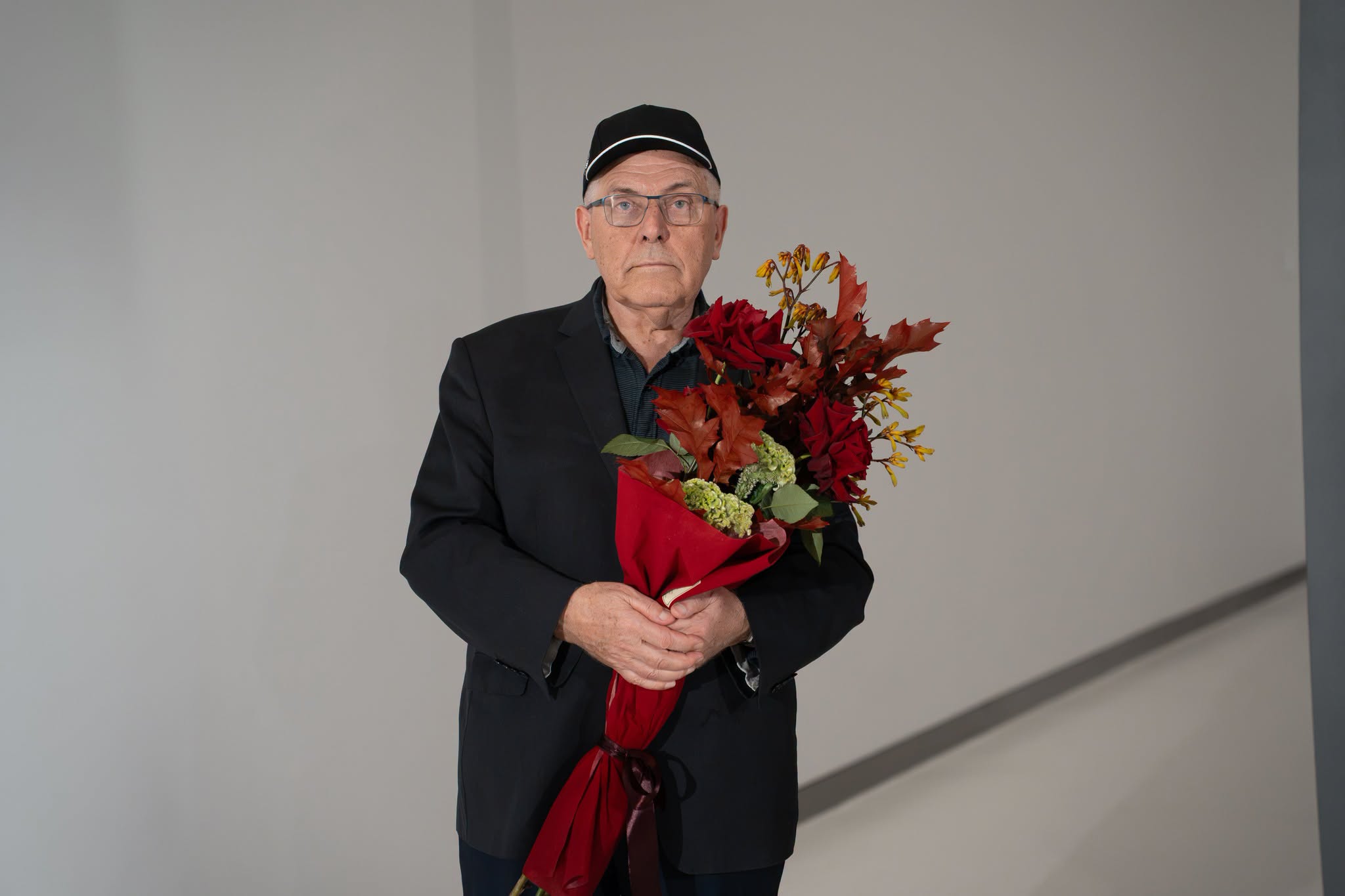
“Wherever I am, whatever I talk about or wherever I travel, I always emphasise my childhood and youth. Contemporary artists sometimes dislike talking about such things. They want to talk only about the ultra-contemporary, modernity, outer space and things that are intangible. But I have no hesitation in talking about the past,” says artist STASYS EIDRIGEVIČIUS.
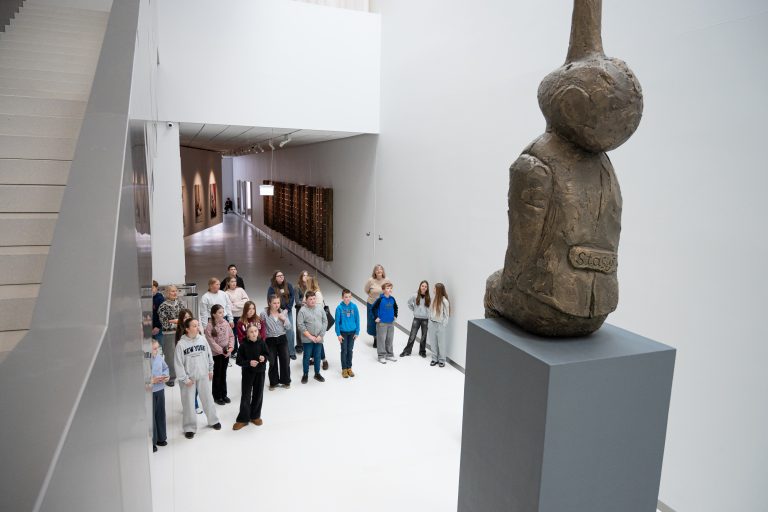
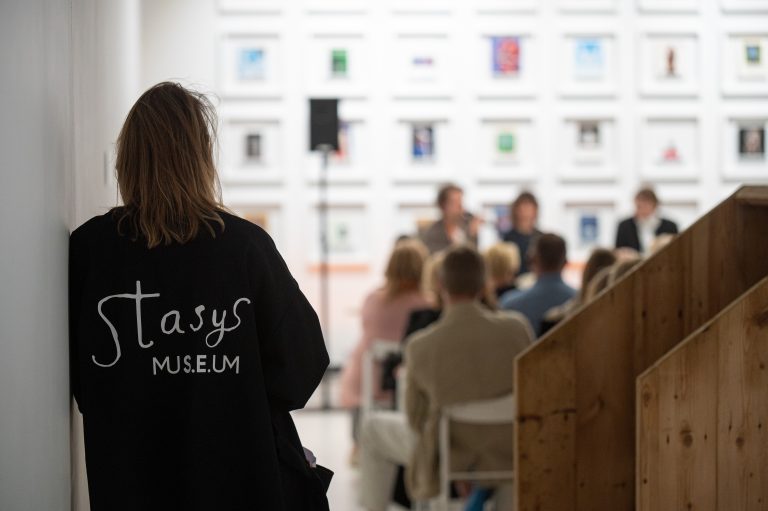
On October 30, a new exhibition of S. Eidrigevičius’s photographic art, entitled And Everywhere I See a Face, opened at the modern and contemporary art museum Stasys Museum. This newly developed artistic form, in which traditional artistic media – photography and drawing – meet in the digital space, is being presented in Lithuania for the first time.
We talk to S. Eidrigevičius about creative freedom, the magical taste of his mother’s bread, the connection between art and people, and the faces found in the surrounding environment and drawn in different colours.
Visitors arriving at the exhibition opening are greeted by dark rye bread. It also features in the exhibition itself: there is a loaf of bread on display, and bread can also be seen in the photographs hanging on the walls. What does this element of the exhibition mean to you?
Bread does not play a dominant role in my life. It is visible because people respect and love it. My son’s children adore it, so I always have to bring them a loaf, two or three. My sister sometimes sends me as many as five loaves by courier, while the municipality gives me one decorated loaf for my name day or birthday. People love bread.
My mother used to bake exactly the same kind of bread – bread with its own magical taste. When travelling around the world, I would always take at least a small piece with me. It would be my gift or a surprise.
Sometimes, before tasting it, people think: “We’ve been given a piece of bread. What’s so special about that?” But once they taste it, they immediately appreciate it – it is a miracle.
So, for you, bread is not only the taste of Lithuania but also the taste of childhood?
That’s true. To some extent, it reminds me of childhood. Wherever I am, whatever I talk about or wherever I travel, I always emphasise my childhood and youth. I also described how I grew up in my poem The Singing Rooster’s Head.
Contemporary artists sometimes dislike talking about such things. They want to talk only about the ultra-contemporary, modernity, outer space and things that are intangible. But I have no hesitation in talking about the past. And most importantly, when I tell these stories, people listen sincerely.
For example, I once gave a lecture at a university, where around seven hundred students were sitting in the auditorium. I had written down in English what I was going to say and was supposed to show photographs of the Lithuanian countryside. I thought to myself: “I have thirteen pages of notes, but I’ll start by saying something of my own, spontaneously.” And do you know what I felt? I immediately established a connection with the audience – they were listening! I realised that reading from my notes at that point would be inappropriate. I had to speak.
And so I did. After the lecture, one of the lecturers said: “You have created a new English language, and we understood everything.” I thought – now that is recognition! I had tried to read from my notes, but it turned out that communicating directly was much better. This happens everywhere: when someone reads from a piece of paper, everything becomes dry and uninteresting. They become so cautious, worrying about saying something incorrectly.
How can this kind of sincerity be achieved through art?
It is much the same in art. If you have noticed, every one of my works has a thought behind it, an entirely different idea. This is my strength. For example, when creating ex libris designs, I would always look at a person’s profession and weave something from their world into the work. For an architect, for instance, I might include something related to a house.
I once created a work for my teacher, Silvestras Džiaukštas, who had taken me into his studio and shown me which works I would be allowed to exhibit and which I would not. The work I made for him featured a mask floating within a frame, one side facing one way and the other side facing the opposite direction. I incorporated a metaphor reflecting the words he had said to me. Whether someone will read this message is another matter. A sensitive person will understand it, while someone else might think: “It’s just imagination.” And there is no need to analyse everything completely, because a metaphor is silent and intended for a sensitive person.
But when these things come together, an appreciation emerges; something has been expressed in simple language. This means you do not try to be ultra-modern or search for new techniques – you have something to say using simple means. And that is what matters most: having something to say.
What did you want to communicate through your new exhibition? Who is it intended for?
The exhibition focuses on what I have on my computer, which I carry with me everywhere. For example, I can photograph this empty café where we are sitting, sit down at my computer and draw people gathered here. They are not actually here, but with a black line I can draw one, two, three or four people sitting here. It is a kind of miracle – seeing something that would never even occur to someone else.
For example, there are pipes in the museum courtyard. At first glance, they seem rather ordinary, but in the exhibition those two pipes turn into legs. Actually, I wanted to install a sculpture outside here, but the director started explaining that the fire brigade needed access and so on, and she did not agree. So I simply turned those two legs into a sculpture on my computer.
It is a kind of joke and a game. After all, we cannot live our lives thinking only about the dramas of the world. We need to laugh a little and relax. We all know that at the beginning of November people visit cemeteries – it is a brief moment of sadness, remembrance and paying tribute to those who have passed away. But we cannot be sad day after day. Children are growing up, after all, and we need to play with them, talk to them and know how to pass on the beauty created in the world. There are so many events happening around us, history is becoming increasingly complex, and there is so much literature, so many museums and artists…
Many people nowadays live like little animals. They see nothing, they look at nothing – all they want is to eat, get dressed, have a car and own a house. Sometimes, when I fly to a summer resort or a hotel, I can already tell what kind of people are on the plane: how they behave, how they talk and what their vocabulary is like. It then becomes obvious that art means absolutely nothing to them.
Why do you think this difference between people exists?
You know, I go to the gym and sometimes buy a package of ten or twenty sessions. The fitness trainer supervises me, telling me to raise a leg, lift an arm or do a certain number of push-ups. Afterwards, I tell him that I am an artist. One of the trainers once suggested an exchange: training sessions in return for a painting or a graphic work. He even came here for the exhibition opening and said: “When you come back, drop by and I’ll give you a tracksuit for free.” That was nice.
With another athlete, from whom I had also bought a similar package, I tried to strike up a conversation. I said: “Look, I sent you an invitation to the exhibition. Did you have a chance to see it? Did you find it interesting?” And he replied: “Come on… I’m a fitness trainer. Don’t bother me with art.” I wondered: this man looks good, he is young, fit and educated, but what is going on inside? He simply stated bluntly: “I’m an athlete. I’m not interested.” Do you understand?
Returning to the idea behind the exhibition, its title is And Everywhere I See a Face. During the performance, you say that the faces in the exhibition are either happy or sad. When you notice a face in your surroundings, how do you sense its emotion? How do you decide whether it will be happy or sad?
I often tell interviewers about the time I came to my studio and found that the door had been broken open. The burglars had stolen nothing – there was nothing worth stealing, apart from rubbish. I photographed the damaged door. Instantly, I felt that it would become a work of art. So I transferred the photograph to my computer straight away.
I am grateful to the curator for selecting this work. She could easily have dismissed it, thinking: “Why would we need some kind of hole?” But this photograph captures a part of my biography and reflects the realisation that an artist is never entirely happy. I devote all my attention to my creative work, so other things – even the studio itself – take second place. That is precisely why the studio in Warsaw, which I rented for fifteen years, was eventually broken into.
I am glad that this moment has been preserved. Of course, it would also help the viewer to know the circumstances. Some works speak for themselves, while others need an explanation. The hole left after the break-in acts as a sign, stopping passers-by and encouraging them to wonder: what exactly has the artist photographed here? If I had tried to paint or draw such a hole myself, including all its cracks, I would never have achieved the same realism. Besides, it would have made no sense. Reality itself presented me with this subject.
And happy moments… They are found in nature, in a blossoming tree, in fresh flowers that I buy from a nearby shop and later photograph. Sometimes, even an unexpectedly purchased teapot is enough: the drink poured into it creates colour, while the hanging tea bags resemble eyes – and this becomes a work of art.
Celebration and sadness always meet in my creative work. The birth of a child is a celebration, a wedding is a celebration, while a funeral is a different occasion to meet people and bow one’s head. It is a celebration of sadness, which is perfectly natural. I do not pretend to be a super-artist, nor do I attach myself to any particular art movement. That is why many art theorists do not even know how to categorise Stasys – is he a surrealist, a cubist or something else? People do not want to delve too deeply.
You keep mentioning the creative process behind the exhibition – photographic art. What happens when photography meets drawing? How do these two forms complement each other?
The photographs in the exhibition come from my travels. Everything I encounter and see becomes documented. For example, I live alone, so talking to flowers is almost like communicating with another person. I change their water and watch to see how long they last. If the flowers survive for three weeks, I write to everyone: “You know what? My flowers last for three weeks. It’s a miracle!” But if they droop after two days, I think: I must have bought old flowers; the seller tricked me.
And what do I do then? I take the flower petals, arrange them into a composition and photograph them because I feel sorry about throwing them away – even the petals have something to say. I create a composition without a face, using only petals, because I find it beautiful. After all, I had those flowers, I know their story, and I preserve it in this way. That is what photography is for – to capture and preserve things.
I used to photograph my little son, and now, when I show him those old photographs, he compares them with his own children or with me. “Oh, look how much I looked like you!” he says. I reply: “You may look like me, but remember that I am a demanding person.”
Being demanding is a very important concept to me. If you approach everything without high standards, nothing will come of it. For example, if the builders had constructed this museum without demanding standards, everything would start falling apart. High standards are necessary everywhere: in art, when preparing exhibition plans, and in the way a museum is managed.
Are you just as demanding of yourself?
If I were not demanding of myself, I would never have achieved anything. I recently visited Japan and wondered why Stasys is welcomed there with open arms. Perhaps it is because people see in me a natural, authentic human world.
For example, I have a work featuring a photograph of a chair stuck between wooden planks. A little figure is drawn on the planks, alongside a winding, blood-red path. It is a real incident from my life. I went to an exhibition at the Museum of Contemporary Art in Warsaw, where three works by Mikalojus Konstantinas Čiurlionis, brought from Kaunas, were also on display. After viewing the exhibition, I was in a good mood and approached a small table with a cup of coffee and a glass of wine on it. I placed a chair on the wooden floor and sat down. At that very moment, one of the chair legs sank into a gap between the old floorboards. My skin was scraped until it bled!
I thought I would go to the café and ask whether they had a bandage I could wrap around the wound. They had nothing! But I did not make a scene because the exhibition was excellent and I was in a positive mood. However, I photographed the incident and drew it, and now viewers look at it and think: “The artist has drawn something here, photographed something… a chair…” But in reality, a genuine event has been documented through my personal experience.
And how do you react to criticism? For example, if someone does not understand what you wanted to say with that bloody leg?
You know, in art nowadays, things often work like this: someone pours out a box of paint – and suddenly it is a painting! I simply cannot understand it. I pour out a box of paint, and suddenly I am fashionable, and my work is hanging in a gallery. The word “prostitution” comes to mind. The prostitution of art.
We want to turn everything into art: this table is art, a hat lying there is art. So, if we already recognise everything as art, then we should be more lenient. Look, even those fire pipes outside the window here become art.
So how would you define art? When, in your eyes, can something be called a work of art?
If it touches me, there must be meaning behind it. Among the countless artists whose work I have seen, there are some whose creations move me. For example, Francis Bacon. When I look at his work, I see that distortion, that force flowing from it… Even when looking at a printed reproduction, you immediately sense an intense nerve, a powerful energy. That is the true power of a painting! Of course, it is far from convincing to everyone.
Another painter who interests me is Lucian Freud. He is a realist, but in a very distinctive way – nothing like Soviet realism. He is incredibly stubborn and an outstanding professional. I look at his paintings and marvel: how does he manage to paint people lying down so convincingly?
There is also David Hockney. He even wrote his address in my little book and invited me to visit him in Los Angeles. We met at the Pompidou Centre during an exhibition opening, and later we saw each other in New York. We have a photograph together. Of course, there are no long conversations at exhibition openings – just “hello, hello” and that’s it. But he, too, is an outstanding professional who knows how to draw and paint exceptionally well and has great mastery of figurative composition and colour.
Later, Hockney became so free that he simply kept drawing and drawing – he no longer paid attention to any rules, just recording what he saw: magnificent nature, valleys, forests and meadows in all their colours. I am always amazed by how much strength and energy he has, and how he pours everything out without giving a thought to how it will be received. He is a completely free and recognised artist who seems to be allowed to do anything: he can draw a naked person or someone dressed, someone dancing, running or swimming – everything flows…
So freedom is one of your greatest values in art.
Very much so.
Finally, your exhibition works were first presented in Japan, where they received considerable acclaim. Do you think Lithuanian audiences see the same meanings in these works, or does the Lithuanian context give them a different perspective?
I do not think the purpose of an exhibition is to sit every person down and examine them: did you like it, did you dislike it, what didn’t you like? None of my works has been created so that I can ask people for their opinions. What is presented here is my world, my inner self, which I create.
Anywhere in the world – whether at the Louvre or the Prado Museum – people walk through some galleries very quickly, while stopping in front of other paintings. For example, in front of the Mona Lisa, because everyone knows that you have to photograph it, admire it and see it: if you have seen it, it means you have been to the museum, and nothing else is necessary. This is a question of how we receive art. We must be free.
Article originally published on bernardinai.lt.


Related news
-
 Museum opening hours on November 19th.
Due to planned electricity maintenance by ESO on November 19, the museum will be open…
Read more -
Newly appointed Board of Stasys Museum held its inaugural meeting
On 30 October, the newly appointed Board of Stasys Museum held its inaugural meeting. The…
Read more -
Changes to Museum Access
On October 21, from 5 to 7 p.m., access to the Children’s Forest Pavilion and…
Read more